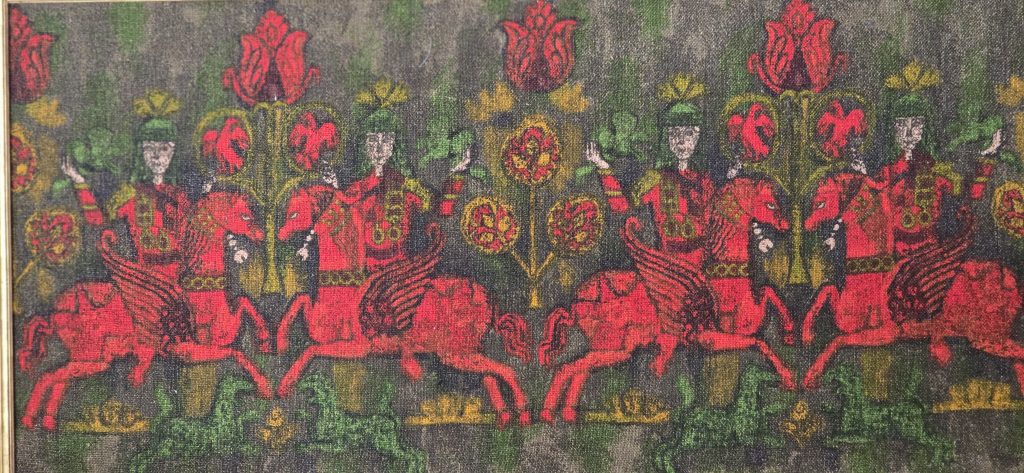
Persian tapestry, 19th century, Iran
In the 19th century, Iranian art became synonymous with Qajar art, that of the dynasty which ruled Iran for more than 150 years. This period, a true golden age of Iranian art, saw the flourishing of disciplines such as miniature painting, manuscript illumination and ornamentation, large-format oil painting, bookbinding, wood carving, marquetry, and metalwork. Early in the Qajar reign, and prior to the establishment of exchanges with the West, Iranian art remained deeply rooted in national tradition, drawing inspiration from the models of earlier historical eras. Subsequently, under the reigns of rulers such as Nasser al-Din Shah and Mozaffar al-Din Shah, Iranian art—and painting in particular—began to draw inspiration from Western art, while still preserving the fundamental characteristics of authentic Iranian art.
