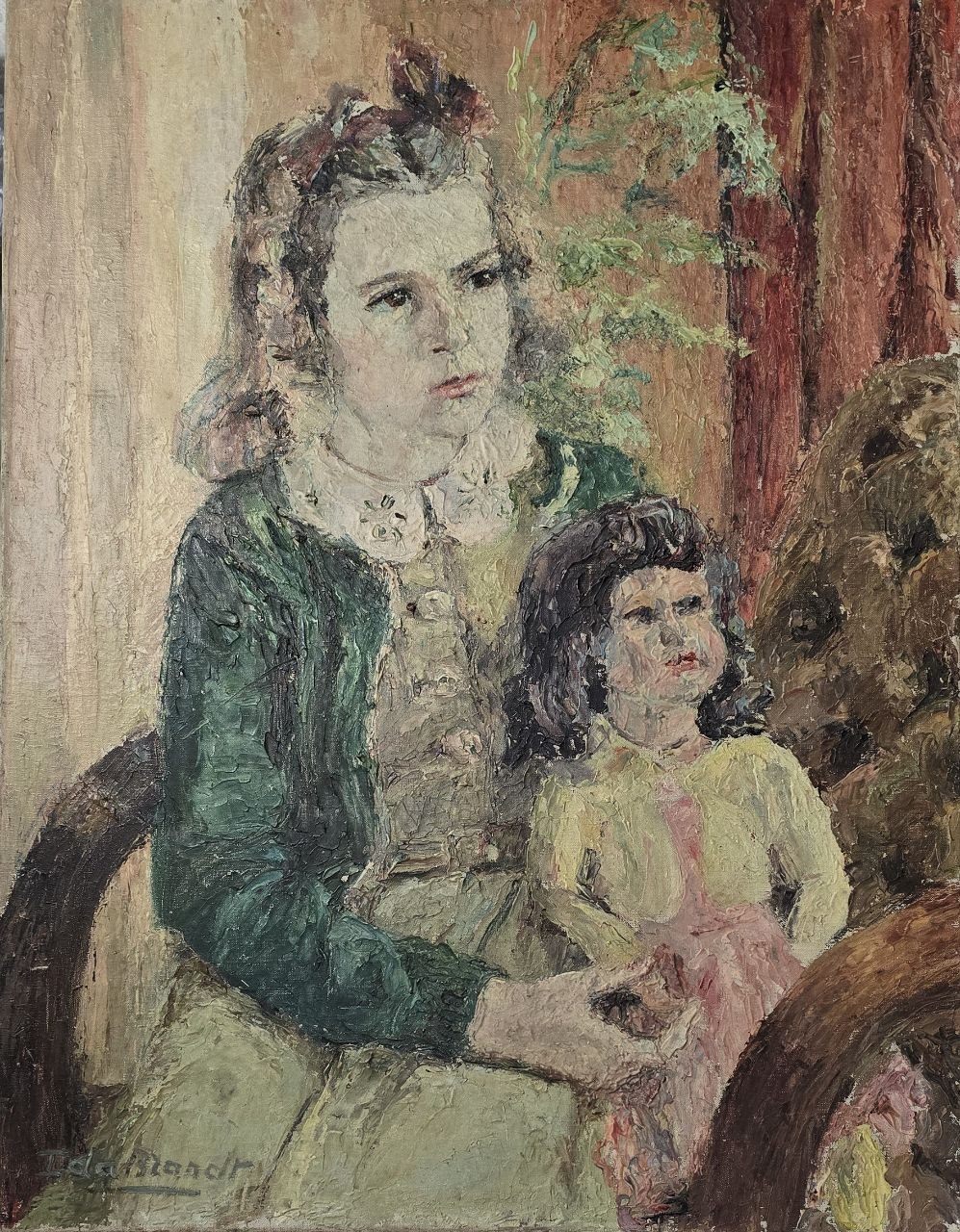
Oil on canvas, 1944
© 2026 Shiraz Art Museum.
Born in Biennedhs on April 14, 1904, Ida Brandt passed away in 1984. She was the youngest of nine children—five boys and four girls. Her first passion was the piano; at seventeen, she went to Bordeaux, dreaming of becoming a concert pianist. There, she won a scholarship to the Conservatory and studied under Joseph Thibaud. Her training subsequently took her to Paris, where she attended classes at the École Normale de Musique and associated with Alfred Cortot. At twenty-five, plagued by stage fright before every concert, she realized that this path was not for her. It was in Paris that she discovered Impressionist works, sparking a genuine passion for art within her. Because the École des Beaux-Arts imposed an age limit, she was unable to enroll there. Nevertheless, she attended art history and drawing classes as an auditor at the Museum of Archaeology and the Faculty of Letters in Paris, under the guidance of Edmond Vallois.
In 1933, she settled in Bordeaux, where she began regularly exhibiting her work in galleries and at the Salon des Indépendants—an event in which she participated at least seven times in less than a decade. At the outbreak of the Second World War, many artists chose to leave the major cities to settle in the Indre department. She established herself in Châteauroux with one of her nephews, Charles Vuilliomenet, and reunited there with a close friend, Marthe Demarty, with whom she shared a passion for art. To earn a living, she worked as an accompanist at a dance school. Despite the restrictions imposed by the war, the local art scene was flourishing. During this period, she gained recognition through portrait commissions, forged ties with other artists, and significantly refined her technique. The portrait of the sculptor Ernest Nivet—a student of Auguste Rodin—which she painted in 1943, bears witness to this.
Bolstered by this experience, she returned to Bordeaux in 1950 for an exhibition at the Amis des Lettres gallery. She achieved resounding success there, earning acclaim from the press. Her time in France brought her a degree of renown and allowed her to make a full living from her art; indeed, she was quickly recognized as a French artist in her own right. However, her return to Switzerland in 1951 marked a sharp break with this flourishing period. Although she organized several exhibitions, her profile was far more modest during this time. Having returned to Biel for family reasons, she lost her studio due to her prolonged absence from France. In 1954, she settled in Evilard in a dilapidated house. While she continued to receive occasional commissions, she never achieved financial comfort, prioritizing artistic freedom instead. An independent woman, she refused all outside assistance, including old-age benefits.
Original text in french by: Coraline Gajo & Caroline Ferrazzo, 30/06/2025
Bibliography
The content of this entry is drawn (and sometimes slightly adapted) from:
Caroline Ferrazzo & Coraline Gajo, Bienne et les arts au féminin, Orbe, Château & Attinger, 2024.
© 2026 Shiraz Art Museum. All rights reserved. Any reproduction, representation, or distribution, in whole or in part, without prior authorization is prohibited.
Laisser un commentaire