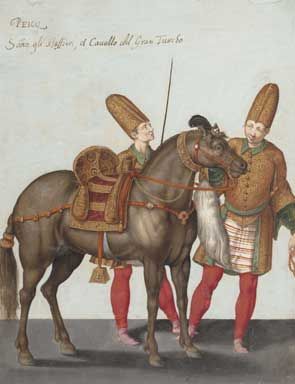
Location: Metropolitan Museum of Art as part of the David M. Tobey Collection
One of the finest examples of late sixteenth-century European depictions of the Ottoman world.
Here is some background and analysis:
Basic information:
What the image depicts
- Artist: Jacopo Ligozzi
- Title: Two Persian Grooms Holding a Sultan’s Horse
- Date: c. 1580–1585
- Medium: Pen and brown ink, watercolor, gouache, and gold on paper
- Nationality of artist: Italian
- Period: Late Renaissance (Mannerist tradition)
What the image depicts
The drawing shows two elaborately dressed attendants standing beside a richly caparisoned horse. The inscription identifies them as Persian grooms, although the title also refers to the horse as belonging to a sultan, reflecting the European tendency to associate luxury and eastern courts broadly with the Ottoman Empire or Persian Empire.
Several details emphasize wealth and status:
- The horse is decorated with luxurious harnesses and an ornate saddle.
- The attendants wear long embroidered coats, patterned textiles, and distinctive tall turbans.
- Bright red stockings and carefully rendered fabrics highlight the richness of their clothing.
- Gold paint adds a sense of luxury appropriate to an imperial court.
Historical contex
During the sixteenth century, Italy maintained extensive commercial and diplomatic contacts with both the Ottoman Empire and Safavid Empire. These exchanges brought ambassadors, merchants, luxury textiles, horses, and illustrated books into European cities.
European artists became fascinated by:
- Exotic costumes,
- Horses,
- Military equipment,
- Diplomatic ceremonies,
- And courtly pageantry.
Rather than inventing these figures entirely, artists like Ligozzi often worked from direct observation, sketches of foreign visitors, or collections of costumes owned by European courts.
Artistic significance
Ligozzi was renowned for his extraordinary precision. His drawings combine:
- Scientific observation,
- Meticulous detail,
- Elegant line work,
- And brilliant color.
This work is notable because:
- Every textile pattern is individually painted;
- The anatomy of the horse is carefully studied;
- The figures are presented almost like ethnographic portraits rather than narrative characters.
The image therefore functions partly as a record of foreign dress and court culture.
Themes
Art historians often discuss this drawing in relation to:
- Cross-cultural exchange between Europe and the Islamic world,
- Renaissance collecting and curiosity about distant cultures,
- Orientalism before the nineteenth century (though this early modern interest differs from later colonial Orientalism),
- The representation of political power through costume and luxury.
Why is this an important topic?
The drawing demonstrates that Renaissance Europe was deeply connected to the wider Mediterranean world. Rather than portraying a battle or religious conflict, Ligozzi focuses on elegance, craftsmanship, and the prestige associated with eastern courts. It reflects both genuine observation and European fascination with the luxury and ceremonial life of the Ottoman and Persian worlds.
Visual analysis
- Composition: The figures stand in profile, creating a calm, balanced arrangement with the horse as the central focus.
- Color: Warm browns, reds, and gold dominate, emphasizing richness and refinement.
- Texture: Exceptional attention is given to embroidered fabrics, leather tack, fur, and the horse’s coat.
- Technique: Fine pen outlines are combined with transparent watercolor washes and opaque gouache, while gold highlights add brilliance.
Overall, Two Persian Grooms Holding a Sultan’s Horse is both an exquisite work of Renaissance draftsmanship and an important document of Europe’s engagement with the cultures of the Ottoman and Persian worlds in the late sixteenth century. It is frequently studied in art history for what it reveals about diplomacy, trade, and visual representations of the Islamic East during the Renaissance.
© 2026 Shiraz Art Museum. All rights reserved. Any reproduction, representation, or distribution of this text, in whole or in part, without prior authorization is prohibited.
Laisser un commentaire