© 2026 Shiraz Art Museum
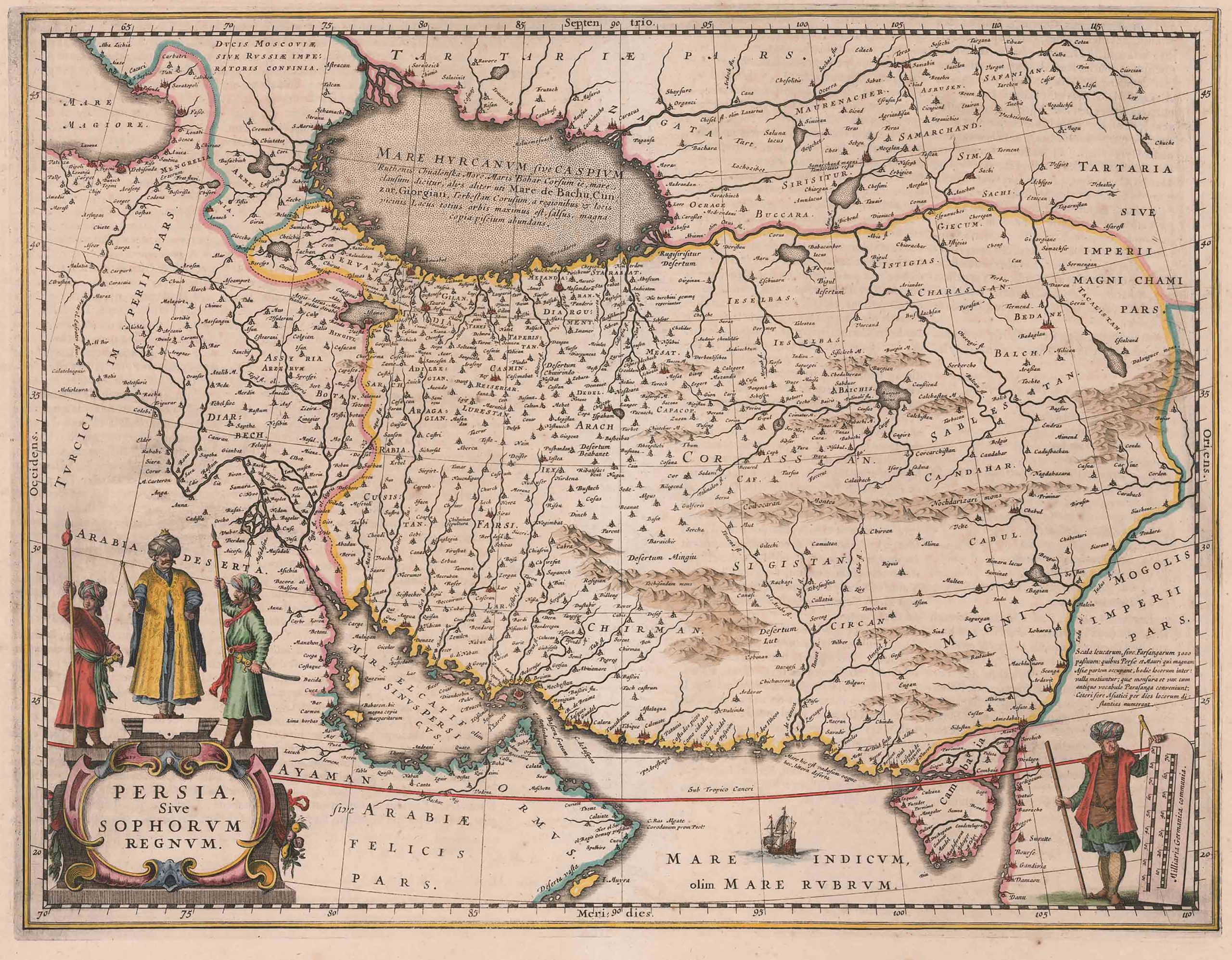
This map depicts the former « Persia sive Sophorum Regnum » (Persia or the Kingdom of the Safavids), engraved and published in the 17th century by the Dutch cartographer Willem Janszoon Blaeu. It covers the Persian Empire of the Safavid era, extending from the Eastern Mediterranean and the Caspian Sea (in the north) to the Persian Gulf, the Sea of Oman (Indian Ocean), and part of Arabia Felix, and stretching eastward to the Indus River and Mughal territory. Located in the bottom left corner, the map’s title cartouche is adorned with figures in costume representing a Persian ruler and soldiers. The dedication, located in the bottom right corner, features a coat of arms and an inscription addressed notably to Theodor Tholing, a senator of Amsterdam. Decorative in style, this map depicts a portion of Asia. It shows, among other features, part of the Ottoman Empire, the Caspian Sea (Hyrcanian Sea), and regions extending from present-day Afghanistan to the Mughal Empire. The inscription also identifies the creator, Willem Blaeu, as well as the date of production. Latin text regarding the region’s name also appears within the Caspian Sea. The text on the reverse side is written in French.
There is no single, unique original copy of this map; rather, there are several original copies dating from that period. In the 17th century, maps from the Blaeu workshop were not unique paintings but engravings printed on paper from original copper plates. These prints were subsequently bound into volumes of Blaeu’s famous atlas (Le Théâtre du Monde or Atlas Maior) and were often hand-colored at the time.
Today, surviving authentic copies of this 1634 map (and its later reissues) are carefully preserved in major heritage collections around the world: The Huntington Library (California, USA) holds a fine, original hand-colored copy dated 1634; the Library of Congress (Washington D.C., USA) houses the Blaeu atlas collection within its geography archives; the David Rumsey Map Collection (Stanford University) holds and digitizes versions from the Atlas Maior; and the University of Michigan Library (Clark Library Maps) possesses a copy of the 1643 French edition. Many other original copies also circulate on the art market through rare book dealers and galleries specializing in antique prints.
The Safavid era (1501–1736) is considered one of the golden ages of Iranian history, marking the birth of modern Persia. This dynasty profoundly transformed the region politically, religiously, and artistically. After centuries of division and foreign rule (notably by the Mongols and Timurids), the Safavids succeeded in reuniting Persian territory under a single central authority. The dynasty’s founder, Shah Ismail I, established Twelver Shiism as the state religion. This strategic choice served to distinguish and protect Persia from its powerful Sunni neighbors: the Ottoman Empire to the west and the Mughal Empire to the east. The reign of Shah Abbas I—or Shah Abbas the Great (1587–1629)—marked the zenith of Safavid power. He moved the capital to Isfahan, transforming it into one of the world’s most beautiful cities (earning it the epithet Esfahan nesf-e jahan, or Isfahan is half the world). He modernized the army with the help of European advisors and cultivated extensive diplomatic and trade relations with Europe to bypass the Ottoman blockade.
Blaeu’s map reflects the fascination Europeans of the era held for the kingdom’s refinement: the Naqsh-e Jahan Square in Isfahan, featuring the Shah Mosque and the Sheikh Lotfollah Mosque, remains an absolute masterpiece of iranian art. This was an era of perfection in the weaving of silk and gold-thread Persian carpets, as well as in the art of Persian miniatures (particularly the Isfahan school). The succession system—under which princes were confined to the harem with no experience of governance—produced weak rulers. Weakened by corruption, ceaseless wars with the Ottomans, and economic pressure, the empire collapsed in 1722 following an Afghan invasion, paving the way for a period of instability prior to the rise of the Afsharid dynasty.
© 2026 Shiraz Art Museum. All rights reserved. Any reproduction, representation, or distribution, in whole or in part, without prior authorization is prohibited.
Laisser un commentaire