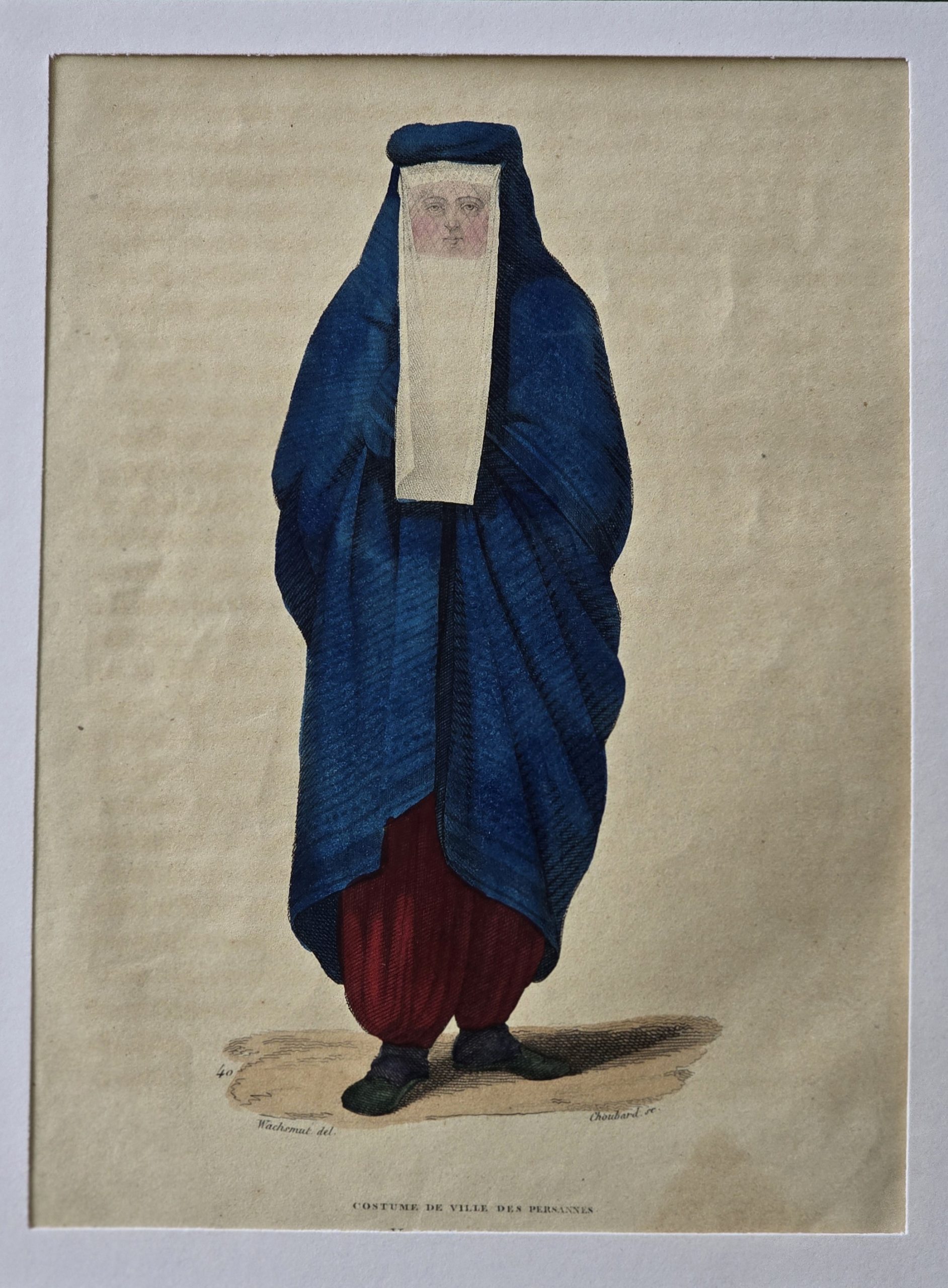
Public costume of persian women by Choubard. Engraving by Wachsmuth. XIXth century
Technique: steel engraving.
Date: c. 1840
Dimensions: 350 × 265 mm (framed)
© 2026 Shiraz Art Museum.
This is an original hand-coloured engraving, not a digitally printed copy. Bought in France.
Illustrating the public dress of a woman in Astarabad (the former name of Gorgan, Iran), this image was first produced by the engraver Ferdinand Wachsmuth, then re-engraved by Choubard (active 1810–1837). The latter’s finer “stipple” version is what we have here, albeit without a definitive print date.
Worn more widely in the past, the chadari – a burqa with a mesh face panel – is today almost exclusively associated with Afghanistan, where it frequently comes in blue.
In Character & Costumes of Afghaunistan (1843), Captain Lockyer Willis Hart describes women’s dress in the capital Kabul thus:
When going out of doors they draw on leggings of cloth, footed with horse leather and gartered at the knee, and envelope their persons in a large garment, called a ‘Boorka posh’, having eyelet holes in front, which completely prevents their being recognised in the streets.
The frame is a custom-painted dark blue.
Bibliography
© 2026 Shiraz Art Museum. All rights reserved. Any reproduction, representation, or distribution, in whole or in part, without prior authorization is prohibited.
Laisser un commentaire