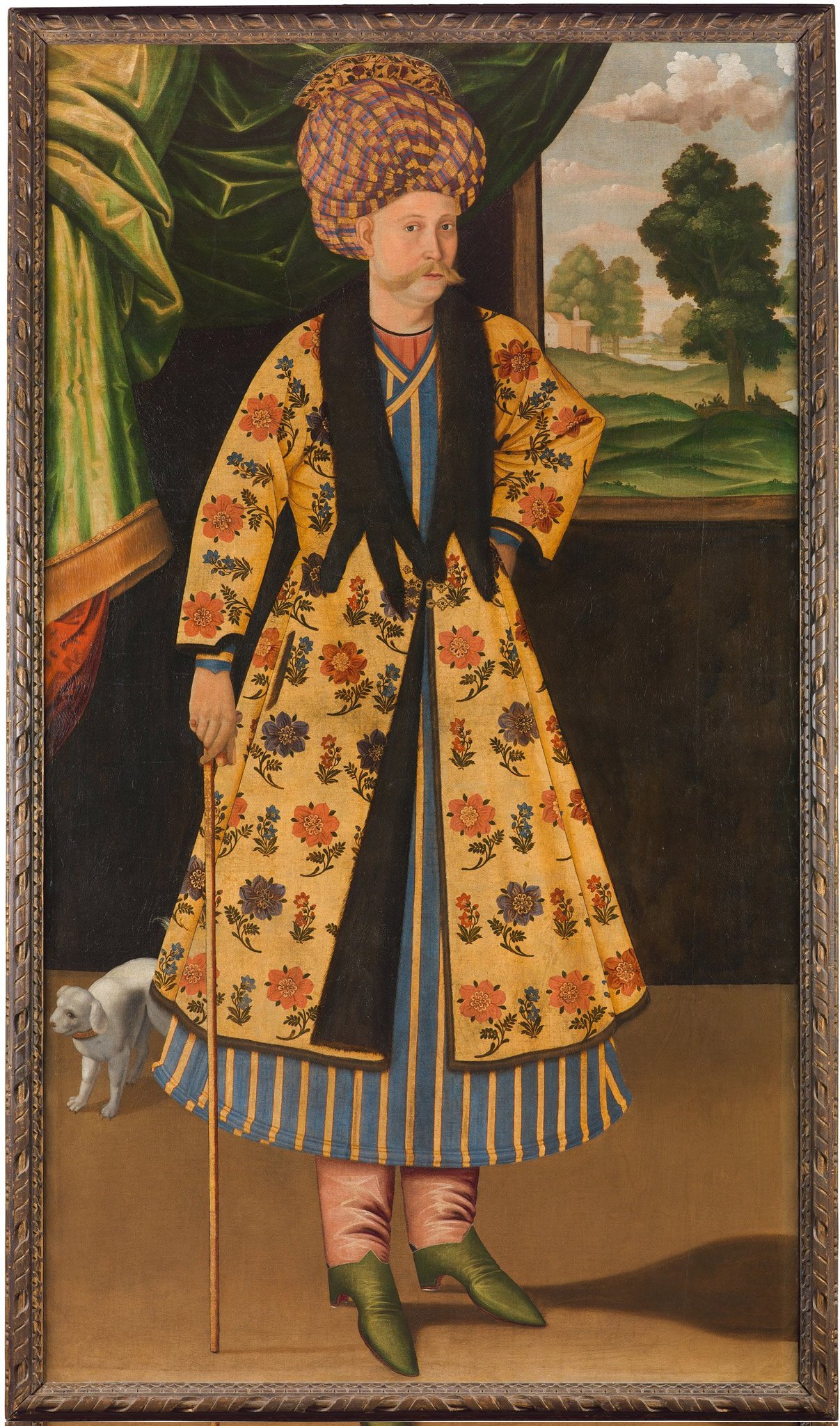
The Mystery of the Gentleman in Turkish Dress vs. Van Dyck’s Masterpiece
During the golden age of global trade and diplomacy, the boundaries of art and fashion became beautifully blurred. A fascinating testament to this era is the phenomenon of European dignitaries adopting the opulence of Middle Eastern courts. By comparing the enigmatic Portrait of a European Gentleman in Turkish Dress (late 17th century, Safavid school) with Sir Anthony van Dyck’s iconic Portrait of Sir Robert Shirley (1622), we uncover a rich, visual dialogue between two worlds.
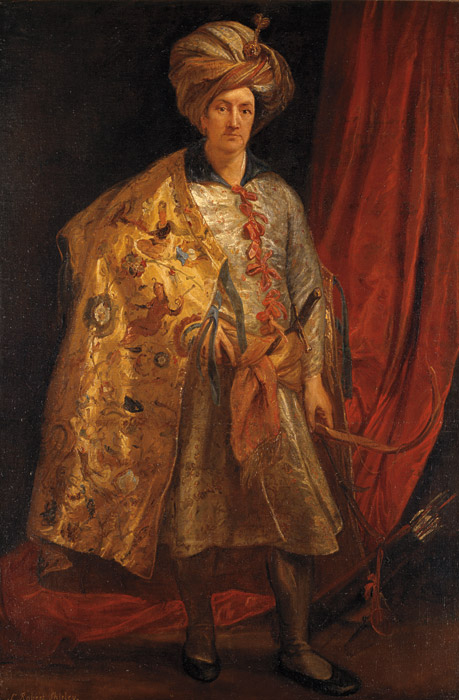
Petworth House (West Sussex, UK)
Despite their different origins, these two masterpieces share striking thematic, conceptual, and staging similarities that highlight an era of mutual fascination.
A Mutual Fascination with Oriental Exoticism
The most immediate connection between both works is the lavish, detailed depiction of Eastern ceremonial attire, used as the ultimate symbol of prestige and worldliness.
- The Imperial Robe: In both paintings, the subjects are depicted full-length, proudly wearing the traditional Persian qaba. These luxurious silk or brocade coats are characterized by dense, intricate floral patterns and opulent fur-lined edges.
- The Majestic Turban: The unknown gentleman in the Safavid painting wears an oversized, colorful, and meticulously draped turban. This striking headpiece closely mirrors the voluminous Persian headdress proudly worn by the English diplomat Sir Robert Shirley in Van Dyck’s masterpiece.
- Diplomatic Posture and Strategic Staging: Beyond the fabrics, the staging of both portraits utilizes identical visual codes of power, authority, and international diplomacy.
- The Stance of Power: The body language in both works is nearly identical. Both men adopt a noble, dignified, and confident pose, with one hand resting firmly on the hip to project authority toward the viewer.
- Symbols of Rank: While their poses match, the objects they hold reflect their specific roles. Sir Robert Shirley holds traditional Persian weapons (a bow and scimitar), emphasizing his military and diplomatic rank. In contrast, the anonymous gentleman leans elegantly on an aristocratic walking cane.
- The Framed Landscape: Spatial composition is used in both paintings to connect the subject to the wider world. The Safavid portrait features a window on the right looking out onto a lush, pastoral green landscape. Similarly, Van Dyck frequently employed theatrical drapery and grand architectural openings to give his European portraits a sense of depth and scale.
- Hybrid Identities and the Rise of « Turquerie »: These paintings are far more than aesthetic choices; they are historical records of a hybrid identity shaped by travel and cultural exchange.
- The Euro-Oriental Synthesis: In the 17th century, European diplomats, merchants, and travelers frequently commissioned portraits in local attire to commemorate their travels and high status abroad. Both paintings perfectly capture this synthesis—blending a distinctly European face with the absolute height of Eastern imperial fashion.
- The Tell-Tale Detail: A crucial clue sits at the feet of the anonymous gentleman: a small white dog. This specific breed is entirely absent from traditional Persian iconography but is a classic signature of European aristocratic portraiture, symbolizing fidelity and wealth. Its inclusion firmly cements the cross-cultural nature of the piece.
- Notable Differences in Artistic Style: While the themes, clothing, and postures align seamlessly, the artistic execution reveals a fascinating clash of styles between two distinct painting traditions:
- Van Dyck’s Western Baroque: The Flemish master’s work is rooted in the pure European Baroque tradition. It relies heavily on dramatic chiaroscuro (the play of light and shadow), psychological depth, and a fluid, realistic rendering of moving fabrics.
- The Late Safavid Execution: The portrait of the anonymous gentleman blends Western perspective with the classical sensitivity of late Safavid painting (the Isfahan school). It is defined by sharp linear finesse, crisp contours, a flatter sense of space, and a vibrant, highly saturated color palette.Ultimately, these two portraits function as historical mirrors. They capture a unique moment in global history when the elite of Europe and the Middle East shared a single visual language of luxury, power, and mutual respect.
© 2026 Shiraz Art Museum. All rights reserved. Any reproduction, representation, or distribution of this text, in whole or in part, without prior authorization is prohibited.
Laisser un commentaire