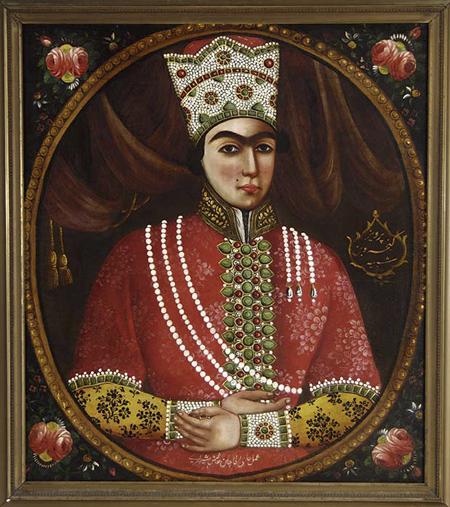
Technique: Oil on canvas
Period: Qajar, ca. 1840
Copyright : Doris Duke Foundation for Islamic Art
This painting is an anonymous portrait of a young Persian prince dating from the Qajar period (circa 1840). Held by the Doris Duke Foundation for Islamic Art, this oil-on-canvas work is highly representative of the aesthetic conventions and court art of 19th-century Iran.
Key elements:
Composition and Framing—Oval format:
The subject is set within an oval medallion, a framing technique that was very popular during the Qajar dynasty for princely portraits.
Floral decor:
The four spandrels (the corner spaces outside the circle) are adorned with bouquets of realistic roses set against a dark background—a recurring motif influenced by artistic exchanges with Europe.
Background:
Behind the prince, draped reddish-brown curtains add depth and reinforce the theatrical, formal nature of the pose.
Physical Characteristics (The Qajar Ideal of Beauty)—Joined eyebrows (unibrow):
The face features dark, thick, continuous eyebrows that meet above the nose. This was a definitive mark of beauty and nobility at the time, for both men and women.
Facial features:
The eyes are large, almond-shaped, and highly expressive, contrasting with a very fair complexion and well-defined red lips. A beauty mark is also visible on the right cheek—another prized sign of elegance. Posture: The figure gazes directly at the viewer with an impassive expression. His hands are calmly clasped at his waist.
Royal Attire and Adornments—The Headdress (Taj):
The prince wears a tall, truncated crown entirely covered in intricate goldsmith work combining a multitude of white pearls and precious stones.
The Red Robe:
He wears a sumptuous red jacket featuring delicate floral patterns (likely brocade or silk).
Jewelry and Ornaments:
The central chest piece and stiff collar are richly embroidered with large green emeralds and pearls. Long, cascading strings of pearls cross his chest asymmetrically. The golden-yellow and black cuffs evoke the luxurious fabrics reserved for the elite.
Written Elements—Calligraphic Inscriptions:
To the prince’s right, a leaf-shaped cartouche contains an inscription in Persian (Nasta’liq script). Another signature or description also appears in white at the bottom of the inner oval border.
While the attire closely mirrors the fashion of Qajar royalty, the Persian inscriptions in the upper-right medallion identify this subject as the legendary Sassanian king, Khosrow Parviz. However, this identification remains speculative. Although the artist’s signature is located at the bottom of the portrait, poor photograph quality prevents definitive confirmation. A faint, nearly illegible inscription at the base suggests the piece may be the work of Haji Abbas Shirazi, a Qajar-era painter who trained in Paris.
© 2026 Shiraz Art Museum. All rights reserved. Any reproduction, representation, or distribution of this article, in whole or in part, without prior authorization is prohibited.
Laisser un commentaire