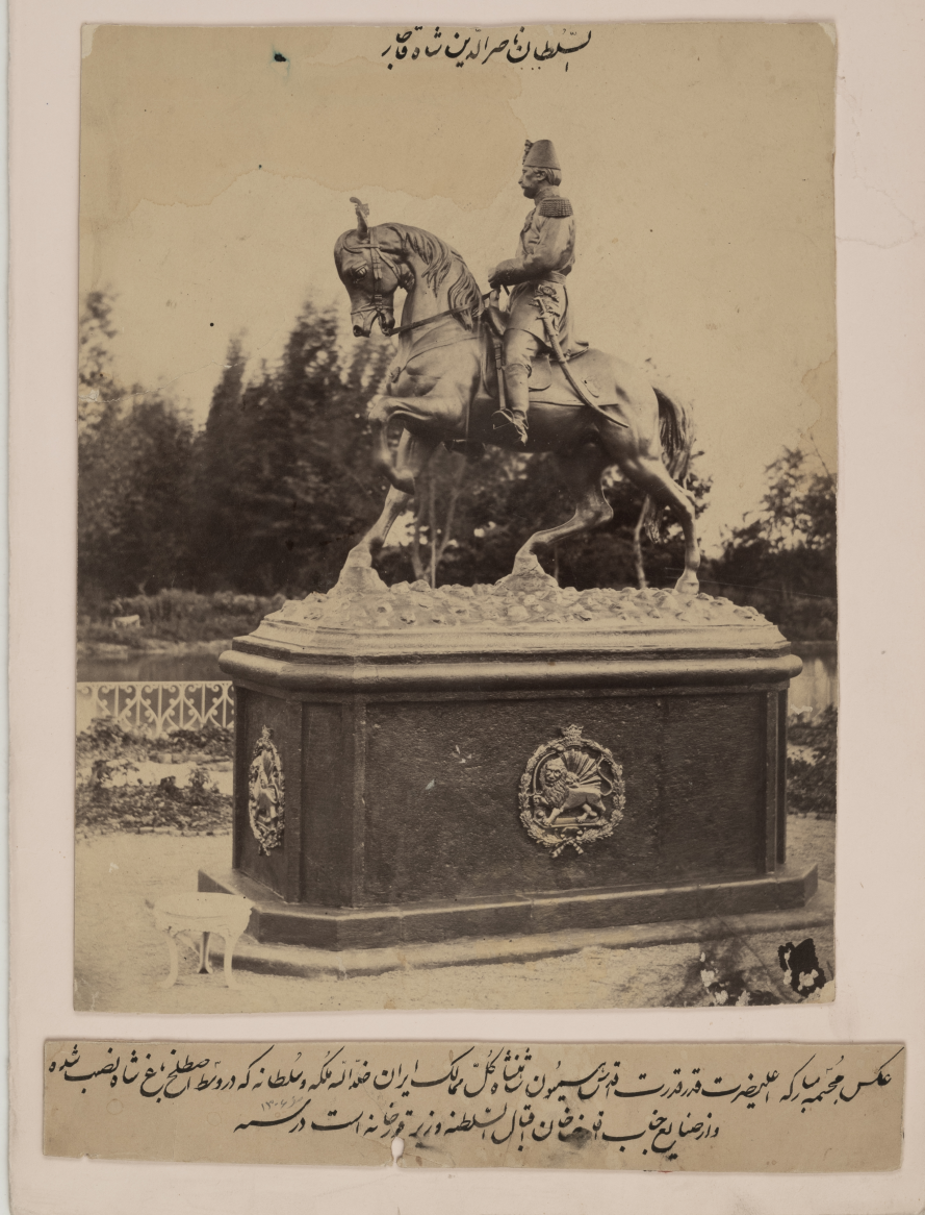
A Unique Historical Monument
The equestrian statue of Nasser al-Din Shah stands as a pivotal monument, marking a profound intersection of art, politics, and religious tension in late 19th-century Iran. Conceived as a bold departure from traditional Islamic aniconism—the strict avoidance of three-dimensional human forms—this bronze masterpiece was unprecedented: it was the first equestrian monument of a Muslim sovereign erected during his lifetime.
Unveiled in the autumn of 1888 to commemorate both the Qajar dynasty’s centenary and the Shah’s 40-year reign, the monument was a highly strategic political statement. Commissioned by the director of the Royal Armory (Qoorkhaneh) and executed by the Persian sculptor Mirza Ali Akbar, the Shah deliberately championed the piece as a triumph of domestic craftsmanship. While its stylistic execution drew heavily from European realism—specifically the celebrated animalier bronzes of Antoine-Louis Barye—its physical placement reflected deep-seated cultural anxieties. To quell potential backlash from the conservative ulama (religious scholars), authorities bypassed Tehran’s main public square (Meydan-e Toopkhaneh or Artillery Square) in favor of the secluded Bagh-e Shah (King’s Garden), anchoring the statue on a pedestal bearing the imperial Lion and Sun emblem.
the Shah visiting his statue at the Qoorkhaneh
Following his visits to European museums, Nasser al-Din Shah ordered a statue of himself from Jahangir Khan Iqbal ol-Saltaneh, the Minister of Industries and Armory. By ministerial decree, Ali Akbar Khan crafted an almost life-size statue of the Shah in formal attire atop a horse in 1887. While the masterpiece rivaled the fine works of European masters, it was built entirely by Iranian craftsmen and artisans. This historical photo shows the Shah visiting her statue at the Qoorkhaneh, or Armory, which is now a station on the Tehran Metro.
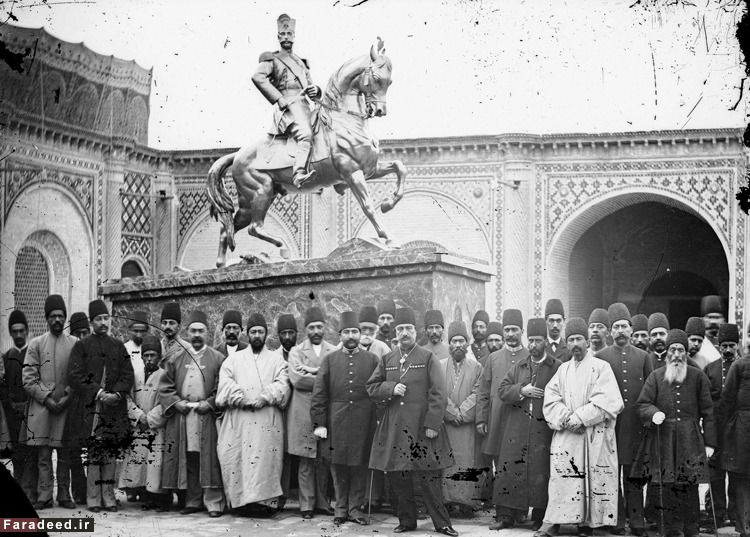
For nearly a century, the statue remained a fixture of the capital until 1928, when Reza Shah Pahlavi—founder of the succeeding dynasty—ordered it dismantled and melted down to supply the national arms industry.
Scenography and Isolation in Kamal-ol-Molk’s Painting
Bagh-e Shah (King’s Garden) by Kamal ol Molk
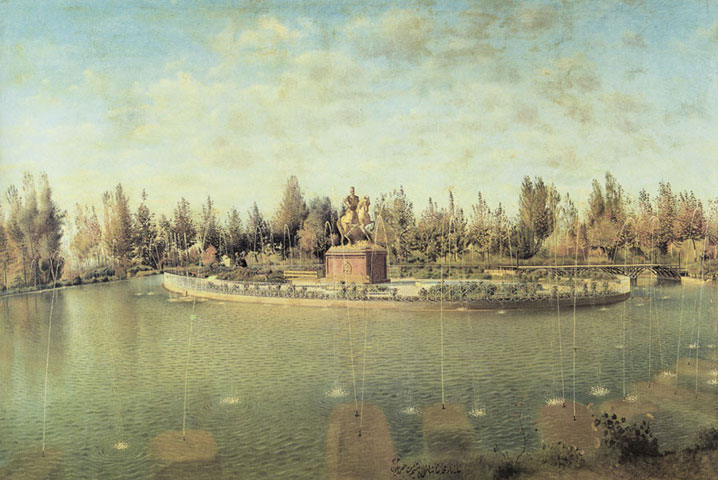
The monument’s complex socio-political reality is masterfully captured in a contemporary painting by the court artist Kamal-ol-Molk. Rather than depicting a passive garden ornament, the painting exposes a brilliant strategy of protective isolation. The statue is elevated on a circular artificial island nestled within an expansive pool. Encircled by a network of dynamic water jets, this layout served an administrative rather than aesthetic function: it established a physical barrier to insulate the controversial human figure from public vandalism and religious iconoclasm.
Culturally, the painting captures a fascinating aesthetic synthesis. It honors the age-old heritage of the Persian garden (Bagh), utilizing central water reservoirs to project life and geometric order against an arid climate. Simultaneously, it infuses European romanticism and municipal modernity. The vertical fountains and landscaped island directly mirror the 19th-century parks of Paris and London, which had deeply captivated the Shah during his European travels. By applying Western rules of linear perspective and capturing subtle, cloudy light reflections on the water, Kamal-ol-Molk creates a powerful scenographic display. The central pool functions as a visual mirror that magnifies the bronze work, forcing court visitors to gaze upward at their sovereign—thereby reinforcing the majestic, theatrical nature of Qajar royal authority.
See Also
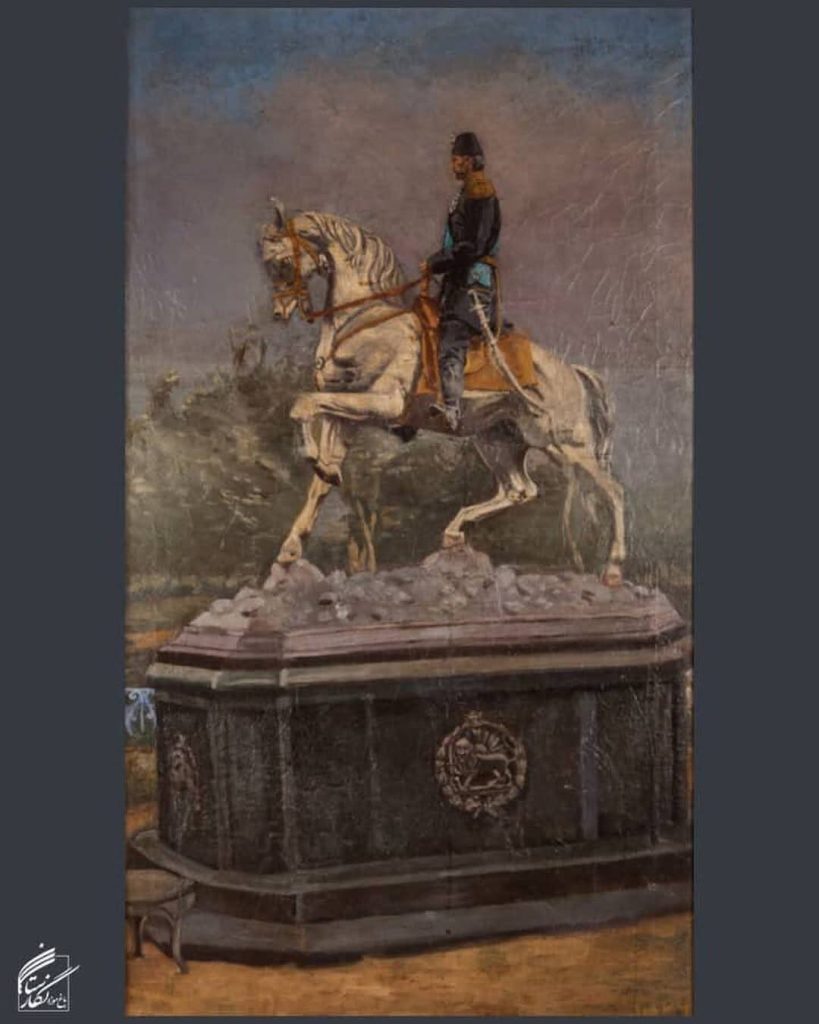
View of the statue of Naser al-Din Shah by Amir Masoud Arzhangi
Year of creation: 1947:
Technique: Oil on canvas
Location: Kamal al-Molk School Museum – Negarestan Museum Garden
Photo: Negarestan Garden Archive
© 2026 Shiraz Art Museum. All rights reserved. Any reproduction, representation, or distribution of this text, in whole or in part, without prior authorization is prohibited.
Laisser un commentaire